How Long Does Ivermectin 24 mg Stay in Body?
How Long Does Ivermectin 24 mg Stay in Your Body? Understanding Ivermectin Duration
When you are prescribed a specific medication like ivermectin, especially at a higher dosage such as 24 mg, it is completely normal to have questions about how long it will remain in your system. Whether you are taking it to treat a parasitic infection or under the specific direction of a medical professional for other health concerns, knowing the ivermectin duration is essential for managing your health and understanding how the drug interacts with your body. Ivermectin is a powerful medication with a unique way of moving through the human system. In this detailed guide, we will explore the science of how ivermectin is processed, the factors that influence its stay in your body, and what you can expect during the days following your dose. We will look at the half-life of the drug, how it is excreted, and why the 24 mg dose specifically matters in this context.
The Science Behind the Scenes: How Your Body Processes Ivermectin
To understand the ivermectin duration, we have to look at the pharmacology of the drug. Ivermectin is lipophilic, which is a fancy way of saying that it dissolves in fats rather than water. This characteristic is a major factor in how long it stays in your body. When you swallow a 24 mg dose, it is absorbed through the gastrointestinal tract and enters your bloodstream. From there, it travels throughout the body, eventually reaching the liver where the real work of metabolism begins. The liver uses specific enzymes, primarily from the cytochrome P450 family (specifically CYP3A4), to break the drug down into smaller components called metabolites. These metabolites are then circulated through the blood until they can be filtered out. Because the drug is fat-soluble, it doesn’t just sit in the blood; it can also be stored in fatty tissues and the liver itself. This storage capacity is why the medication can continue to work for several days even after a single dose. The concentration of the drug usually peaks in your blood about four to five hours after you take it, but the journey is far from over at that point.
The Half-Life Concept and Ivermectin Duration
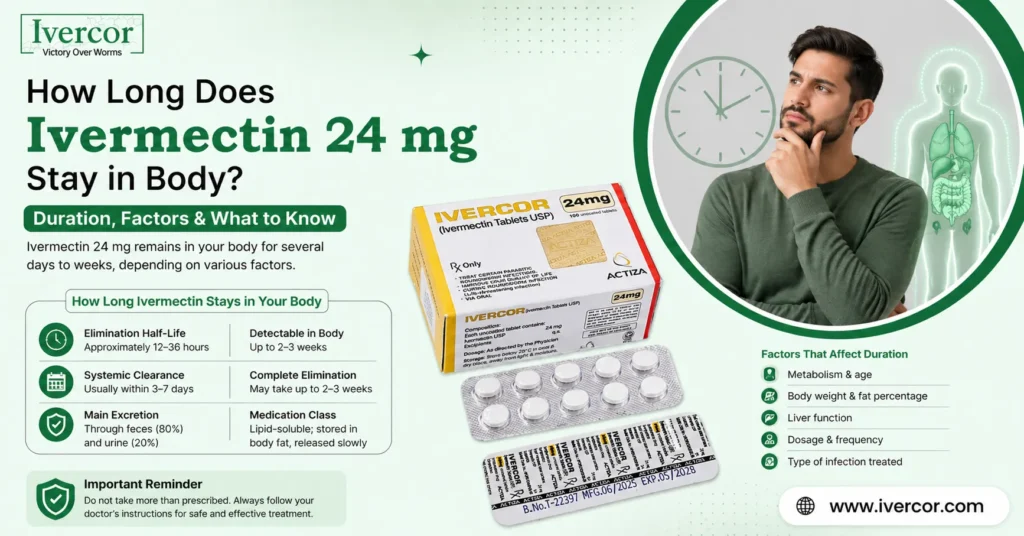
One of the most important terms in medicine for determining how long a drug lasts is the “terminal half-life.” This refers to the amount of time it takes for the concentration of the drug in your blood to decrease by exactly 50 percent. For ivermectin, the average half-life in a healthy adult is approximately 18 hours. However, this is not a fixed number for everyone. Research has shown that the half-life can range from as little as 12 hours to as long as 26 hours depending on various biological factors. If we use the 18-hour average as a baseline for a 24 mg dose, the timeline looks like this: 18 hours after taking the pill, about 12 mg remains active. After 36 hours, 6 mg remains. After 54 hours, 3 mg remains. This process continues until the drug is virtually undetectable. Scientists generally agree that it takes about five to six half-lives for a drug to be considered fully cleared from the system. In the case of ivermectin, this means the ivermectin duration in the bloodstream is typically between 4 to 5 days. However, because it is stored in fat, trace amounts might remain in the body’s tissues slightly longer than they appear in the blood.
Factors That Influence How Long Ivermectin Stays in the Body
While the 18-hour half-life is a helpful guide, several individual factors can significantly change the ivermectin duration for different people. No two bodies are exactly alike, and the way your liver and fatty tissues handle a 24 mg dose will depend on your unique biology. Here are the primary factors that play a role in this process:
- Body Composition and Fat Levels: As mentioned, ivermectin is fat-soluble. This means that individuals with a higher percentage of body fat may find that the drug stays in their system longer. The medication gets “tucked away” in fat cells and is released slowly back into the bloodstream over time. Conversely, someone with very low body fat may clear the drug faster.
- Liver Health: Since the liver is the primary engine for breaking down ivermectin, any issues with liver function can slow down the clearance process. If the liver is busy processing other substances or is damaged, the ivermectin duration will be extended as the drug waits its turn to be metabolized.
- Dietary Habits: What you eat when you take your 24 mg dose matters immensely. Taking ivermectin with a high-fat meal can increase the amount of the drug absorbed into your system by up to 2.5 times compared to taking it on an empty stomach. If more of the drug enters your system, it naturally takes the body longer to process and eliminate the higher volume.
- Age and Metabolism: Metabolic rates naturally slow down as we age. Older adults often have a longer ivermectin duration because their organs process medications more slowly. Younger individuals with faster metabolic rates may see the drug leave their system at the lower end of the time spectrum.
- Drug Interactions: If you are taking other medications that use the same liver enzymes (CYP3A4) as ivermectin, your body might struggle to process everything at once. This competition for enzymes can cause ivermectin to stay in your system longer than usual.
Excretion: The Final Exit Path
So, where does the 24 mg of ivermectin go once your body is done with it? Unlike many other drugs that are primarily filtered out by the kidneys and exited through urine, ivermectin is mostly excreted through the feces. Studies have shown that less than 1 percent of the administered dose is found in the urine. The vast majority is processed by the liver, sent into the bile, and then passed through the digestive tract. This means that your digestive health and bowel regularity can also have a minor impact on the ivermectin duration. If you have a very slow digestive system, the waste products of the medication might sit in your colon a bit longer before being physically removed from your body. Maintaining good hydration and a high-fiber diet can support your body’s natural elimination processes during this time.
Understanding the 24 mg Dosage Impact
A 24 mg dose is a substantial amount of medication. It is usually calculated based on the weight of the patient, often at a rate of 200 micrograms per kilogram. For a person weighing approximately 120 kilograms (about 265 pounds), 24 mg is a standard therapeutic dose. However, if this dose is taken by someone significantly lighter, the concentration in the blood will be much higher. A higher concentration doesn’t necessarily change the half-life (the percentage cleared per hour), but it does mean there is more “total material” to get through, which can make the physical effects of the ivermectin duration feel more prolonged. It is essential to only take the specific dose recommended by a physician, as taking more than necessary can lead to an accumulation in the tissues that takes a much longer time to resolve.
How long after taking ivermectin can I expect side effects to stop?
Since the ivermectin duration in the bloodstream is typically around 4 to 5 days, most mild side effects like dizziness, nausea, or a mild stomach ache should subside within that same window. As the concentration of the drug in your blood drops below a certain therapeutic level, your body begins to return to its normal state. If side effects persist beyond a week, it is important to contact a healthcare provider to ensure there isn’t another underlying issue.
Can a blood test detect ivermectin after a week?
In most standard clinical settings, ivermectin will be very difficult to detect in the blood after 7 days following a single 24 mg dose. While highly sensitive laboratory equipment used in research might find trace metabolites, for all practical medical purposes, the drug is considered cleared from the systemic circulation after about five days. There is no common drug test used by employers that screens for ivermectin, so it is generally not a concern for workplace testing.
Does drinking water help flush ivermectin out faster?
While staying hydrated is always a good idea for general health and helps your kidneys function properly, drinking excessive amounts of water will not significantly speed up the ivermectin duration. Because ivermectin is excreted through the feces and bile rather than the urine, and because it is fat-soluble, it cannot be “washed” out of the system with water. The best way to support clearance is to support your liver health by avoiding alcohol and eating a balanced diet.
Is it safe to take other medications while ivermectin is in my system?
This depends entirely on what the other medications are. Because ivermectin is processed by the liver’s CYP3A4 enzymes, you should be careful with other drugs that use the same pathway. Common substances like certain blood pressure medications, anti-fungals, and even grapefruit juice can interfere with how your body handles the ivermectin duration. Always provide your doctor with a full list of supplements and medications you are taking before starting a 24 mg dose of ivermectin.
Why do some people feel the effects of ivermectin for longer than others?
The difference in the felt ivermectin duration usually comes down to body fat and liver efficiency. If someone has a lot of adipose tissue, the drug can linger in those fat stores and slowly leak back into the blood over several extra days. Additionally, if someone has a mild parasitic infection, the symptoms of the parasites dying off (known as a Mazzotti reaction) can sometimes be mistaken for the drug staying in the system, when it is actually the body’s immune response to the treatment working.
Monitoring and Safety During the Clearance Period
While you wait for the ivermectin duration to run its course, it is important to monitor your body’s reactions. Most people tolerate a 24 mg dose very well, but because it stays in the system for several days, you should stay observant. Keep an eye out for any signs of an allergic reaction, such as hives or swelling, and be mindful of your neurological health. While rare, some people may experience significant drowsiness or confusion if the drug lingers too long or if they have a specific genetic sensitivity. Understanding that the drug is active for about 96 to 120 hours allows you to plan your schedule accordingly, perhaps avoiding heavy machinery or intense physical labor if you find that you feel a bit “off” during the first few days after your dose. The key is patience; your body is a highly efficient machine designed to filter and remove these substances at a steady, biological pace. In conclusion, the ivermectin duration for a 24 mg dose is governed by a complex interaction of fat solubility, liver metabolism, and individual biological factors. While the blood is generally clear of the drug within 5 days, the impact of the medication and its metabolites can be felt for a short time thereafter as your body completes its natural detoxification process. By staying informed and following professional medical advice, you can navigate your treatment with confidence, knowing exactly how your body is handling the medication and when it will be completely back to its baseline state.